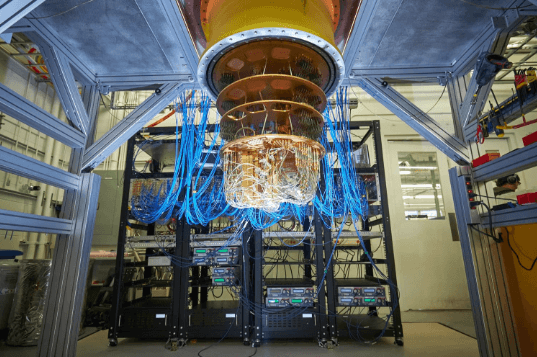
Quantum hardware aims to harness qubits, gates, and coherence to tackle classically hard tasks. Different platforms offer unique encodings, controls, and error profiles, shaping practical paths forward. Real progress requires improvements in coherence, gate fidelity, and scalable architectures, along with robust error mitigation and fault-tolerance strategies. Incremental advances across materials, control software, and modular design will influence which use cases gain traction first, leaving a clear incentive to pursue what lies beyond current capabilities.
How Quantum Hardware Works: From Qubits to Gates
Quantum hardware translates abstract quantum concepts into physical operations by using qubits as the basic information units and gates as controlled transformations. The architecture relies on qubits coherence to maintain state, while error mitigation techniques reduce disturbances. Quantum gates implement precise operations, forming circuits that process information. Throughout, fault tolerance strategies manage errors, enabling reliable computation within noisy environments and scalable quantum systems.
What Makes Quantum Platforms Different (and Why It Matters)
The platforms supporting quantum computing differ fundamentally in how they encode information, control operations, and scale reliability, making practical performance highly context-dependent.
This variance highlights core distinctions across architectures, not just hardware.
Curiosity driven design guides exploration of diverse qubit modalities, control schemes, and error mechanisms, while fault tolerant milestones chart achievable reliability.
Together, they shape applicability, timelines, and the freedom to pursue transformative applications.
Current Roadblocks and Realistic Timelines
Despite rapid progress, several roadblocks constrain near-term deployment of quantum hardware: limited qubit coherence times, imperfect gate fidelities, and error rates that demand substantial overhead for error correction. Decoherence challenges persist across platforms, complicating scalability. Practical timelines hinge on incremental gains in coherence, fabrication reliability, and robust error correction schemes, coupled with cost-effective control. Realistic outlook: gradual hardware maturation, targeted applications, disciplined investment, and modular integration.
Real-World Use Cases Driving the Quantum Leap
Real-world use cases are shaping the quantum leap by aligning capabilities with pressing computational needs. In practice, industries pursue concrete wins: optimization, material discovery, and secure communications, where quantum advantages materialize under constrained, scalable hardware conditions.
Focused on quantum error resilience and hardware scalability, developers prioritize robust, interoperable platforms, avoiding non relevant? approaches while pursuing transferable, freedom-friendly solutions.
See also: francechevalturf
Frequently Asked Questions
How Secure Are Quantum Systems Against Future Cryptographic Attacks?
Quantum systems face evolving cryptographic risks; security may erode as attacks advance, yet quantum-resistant methods and careful standardization offer resilience. Privacy inequities and labor displacement concerns shape deployment, emphasizing practical, liberty-minded strategies for equitable, robust defense.
What Are the Environmental Requirements for Maintaining Quantum Coherence?
Coherence relies on a still, glassy pond: isolation minimizes disturbance, while cryogenic engineering preserves near-absolute silence. Maintaining coherence requires controlled environments, vibration damping, and precise temperature staging, enabling stable qubits despite external fluctuations and thermal noise.
When Will Quantum Advantage Become Practically Accessible for Businesses?
Practically, quantum advantage remains distant; practical adoption for businesses hinges on hardware reliability and cost reductions. As platforms reach higher qubit counts with stable error correction, business readiness improves, though widespread deployment awaits substantial maturation and standardization.
How Do Quantum Error Correction and Fault Tolerance Work in Practice?
Quantum error correction uses redundancy and syndrome extraction to detect errors, enabling fault tolerance in scalable systems. In practice, Preprint workflows and hardware benchmarking guide iterative improvements, balancing resource overhead with actionable, freedom-oriented deployment strategies for robust quantum applications.
What Are the Societal and Ethical Implications of Quantum Computing?
Quantum computing reshapes power, risks, and governance; its societal impact and ethical considerations demand transparent stewardship. A lone observer notes that freedom-minded societies must balance innovation with rights, privacy, equity, and robust governance to mitigate misuse and disparities.
Conclusion
In this sober ledger of qubits and quagmires, the promise remains tantalizingly near—like a perfectly clocked gate that never fails, except it does. Coherence wanes, errors creep in, yet researchers persevere with elegant error budgets and modular, scalable plans. The irony is practical: progress is measured not by a single breakthrough but by incremental, interoperable advances across platforms. If success is a moving target, the real win is the steadily widening path toward usable quantum advantage.